ISO 11607 Package Validation
Ensure the long-term sterility and physical integrity of your medical device packaging. EBI provides comprehensive validation services to protect your product from the point of sterilization to the point of use.

Package validation is a regulatory requirement under ISO 11607, ensuring that the sterile barrier system (SBS) remains intact throughout the product’s shelf life. A failure in packaging is a failure in sterility. At EBI, we utilize standardized ASTM methods to verify both Package Integrity (detecting leaks) and Package Strength (resistance to force).
Visual Inspection (ASTM F1886)
Objective: Identification of the appearance characteristics of unopened, intact seals.
Visual inspection test allows to identify defects that may affect the integrity of the package such as: unsealed or oversealed areas, narrow seals, channels, wrinkles/foldovers/cracks, tears/pinholes.
- Method: Visual evaluation of the unopened seals.
- Compliance: ASTM F1886 „Standard Test Method for Determining Integrity of Seals for Flexible Packaging by Visual Inspection.”
- Turnaround: 4 weeks.
Bubble Emission (ASTM F2096)
Objective: Detecting gross leaks in porous and nonporous packaging.
The Bubble Emission test, often called the „Internal Pressurization Test,” is a highly effective way to identify structural failures in your packaging. By submerging the pressurized package under water, we can visually identify even the smallest steady stream of bubbles indicating a leak.
- Best for: Pouches, trays, and large bags.
- Compliance: ASTM F2096 „Standard Test Method for Detecting Gross Leaks in Packaging by Internal Pressurization.”
- Turnaround: 4 weeks.
Dye Migration (ASTM F1929)
Objective: Identifying channels and leaks within the package seal.
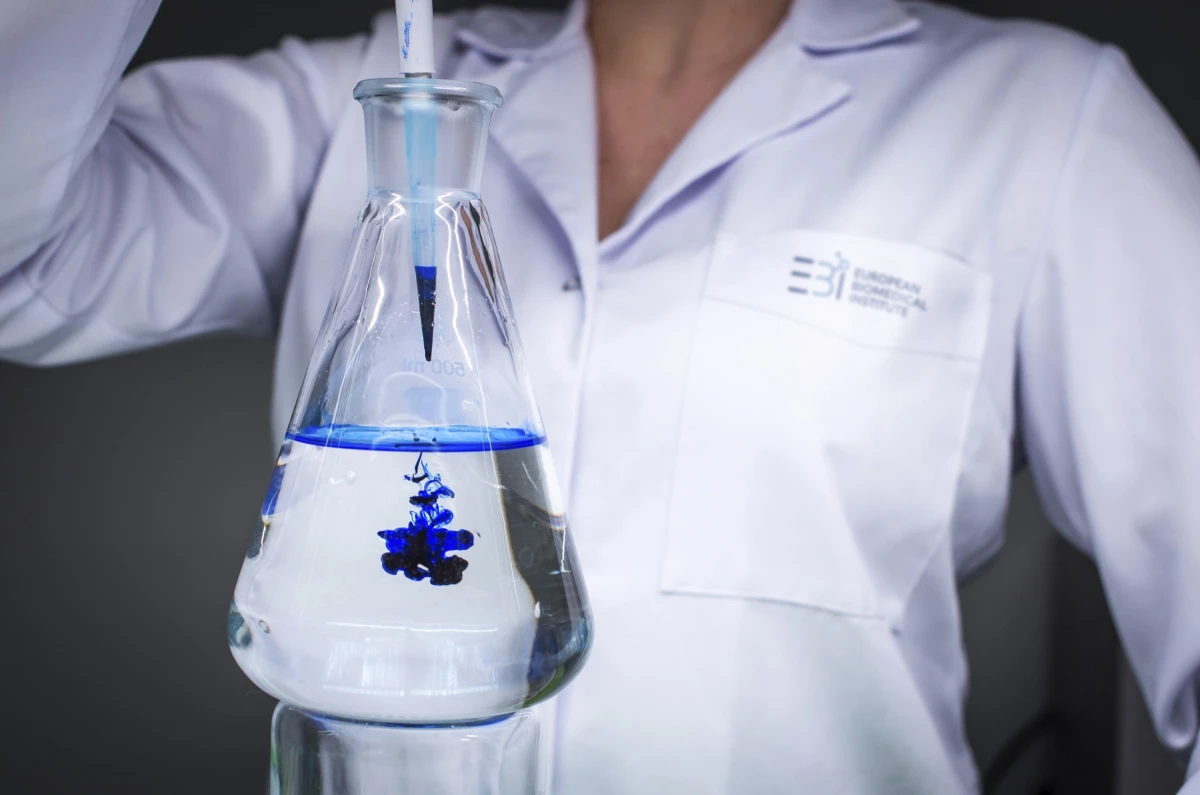
This study is designed specifically for porous packaging (such as Tyvek®) with at least one transparent side. A dye-penetrant solution is introduced into the seal edge; if a channel exists, the dye will migrate through it, making the defect visible to our experts.
- Best for: Porous medical pouches and lidded trays.
- Compliance: ASTM F1929 „Standard Test Method for Detecting Seal Leaks in Porous Medical Packaging by Dye Penetration.”
- Turnaround: 4 weeks.
Peel Characteristics (BS EN 868-5)
Objective: Determining whether the seals peel without any abnormalities.
Peel Characteristics test allows to discover any anomalies in the peeling process such as tearing and generation of fibers. It includes assessment of uniformity and continuity of the peeling.
- Method: Peeling the seals by hand and evaluating the manner of opening the seals
- Compliance: BS EN 868-5 – Packaging for terminally sterilized medical devices, Part 5: Sealable pouches and reels of porous materials and plastic film construction – Requirements and test methods
- Turnaround: 4 weeks.
Seal Strength (ASTM F88)
Objective: Measuring the force required to peel the seal apart.
Seal Strength testing quantifies the consistency of your sealing process. It ensures that the seal is strong enough to maintain a sterile barrier but easy enough for a healthcare professional to open aseptically.
- Method: A 1-inch wide strip of the seal is pulled at a constant rate while the peak force is recorded.
- Compliance: ASTM F88 „Standard Method for Seal Strength of Flexible Barrier Materials.”
- Turnaround: 4 weeks.
Sample Requirements & Logistics
Sample sizes for package validation typically depend on your production batch volume and specific regulatory requirements (e.g., a statistically significant sample size based on an AQL).
- Sample Quantity: Dependent on batch volume and customer-specific risk assessment.
- Condition: Samples should be provided in their final, sealed state.
- Combined Studies: These tests are often performed following Accelerated Aging or Transit Simulation to prove the package remains valid over time.
How We Work

Discovery & Insight
We begin with an in-depth consultation to understand your needs, challenges, and objectives. This helps us define the right strategy and scientific approach for your project.
Design & Development
Our experts translate your vision into actionable plans — combining innovative research, data, and technology to build precise and reliable solutions.
Delivery & Support
We implement the solution with full transparency and ongoing communication. After delivery, we stay involved — supporting you with optimization, updates, and future improvements.
FAQ
What is the difference between porous and nonporous materials?
Porous materials (like Tyvek® or medical-grade paper) allow air/gas for sterilization to pass through, while nonporous materials (like foil or plastic film) do not. We select the test method (e.g., Dye Migration vs. Bubble Emission) based on these material properties.
Is package validation a one-time requirement?
It is required for initial market entry. However, if you change your sealing parameters, change your pouch supplier, or move production to a new facility, a re-validation is mandatory.
What is the difference between porous and nonporous materials?
Porous materials (like Tyvek® or medical-grade paper) allow air/gas for sterilization to pass through, while nonporous materials (like foil or plastic film) do not. We select the test method (e.g., Dye Migration vs. Bubble Emission) based on these material properties.
Is package validation a one-time requirement?
It is required for initial market entry. However, if you change your sealing parameters, change your pouch supplier, or move production to a new facility, a re-validation is mandatory.
Contact with us
We’re open to collaboration and research partnerships. Fill out the form — our team will respond as soon as possible.
Location:
Europejski Instytut Biomedyczny sp. z o.o.
ul. Bartycka 63A lok. 6, 00-716 Warszawa
Mail:
contact@ebi.bio
Phone:
+48 22 780 06 32
Get in touch